
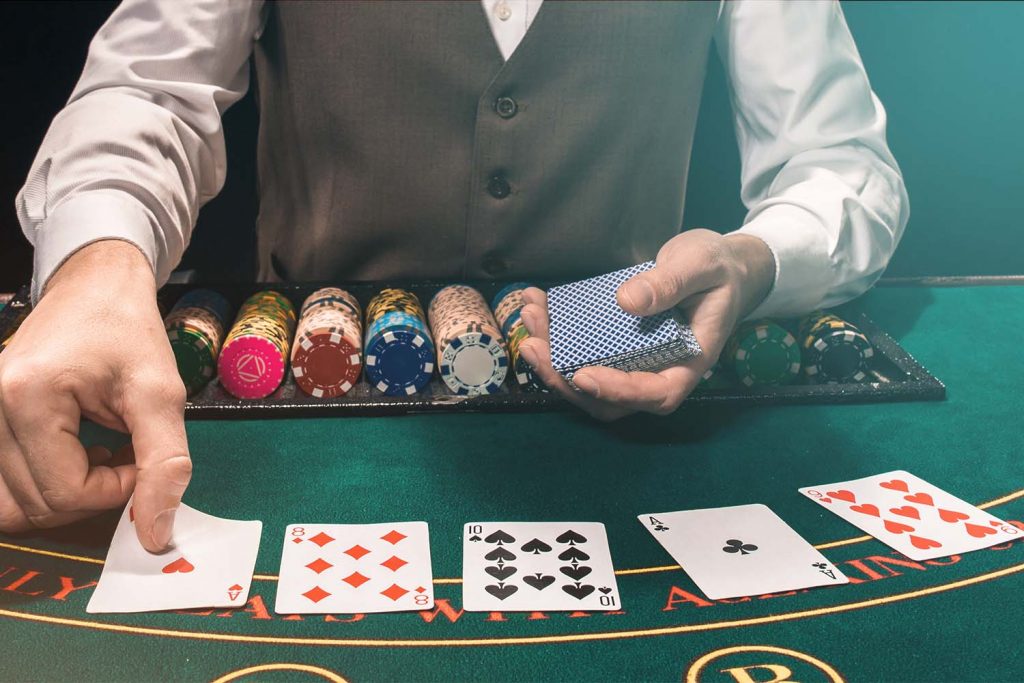
Introduction: The Allure of Twenty-One
Among the glittering floors of the world’s most renowned casinos, few tables command the kind of timeless magnetism as the Blackjack table. More than just a card game, Blackjack has long stood as a symbol of the delicate dance between chance and mastery. Unlike many other casino games that rely solely on luck, Blackjack invites the player into an intimate battle of wits against the dealer, where each card turned can tip the scales between triumph and disappointment. But beneath its seemingly simple rules lies a realm rich in strategy, psychology, and nuance.
A Brief History: From French Origins to Casino Staple
Blackjack’s journey began centuries ago, with roots tracing back to French casinos in the 1700s, where a game called “Vingt-et-Un” — French for twenty-one — captured the imaginations of aristocrats and gamblers alike. Over time, the game evolved, crossing oceans to America, where casinos added enticing bonuses to attract players. One such bonus awarded extra payout if a player held the ace of spades and a black jack, hence the name that endures to this day.
Understanding the Basics: Rules That Shape the Game
At its core, Blackjack is deceptively simple:
-
Players aim to reach a hand total as close to twenty-one as possible without exceeding it.
-
The dealer deals two cards to each player and themselves, with one dealer card usually face up.
-
Number cards are worth their face value, face cards are worth ten, and aces can be either one or eleven.
-
Players then choose to “hit” (draw another card) or “stand” (keep their total), trying to outscore the dealer without busting.
This fundamental structure gives way to countless permutations, turning every hand into a puzzle waiting to be solved.
The Strategy Behind the Cards
One of Blackjack’s enduring appeals is its deep well of strategic possibilities. Unlike pure games of chance like roulette, Blackjack allows the informed player to reduce the house edge dramatically.
Basic Strategy
-
Based on probability and millions of simulated hands, “basic strategy” charts offer players the statistically optimal move for every possible hand combination.
-
This strategy instructs when to hit, stand, double down, or split pairs.
-
Memorizing the basic strategy can reduce the casino’s advantage to as little as half a percent.
Card Counting: The Myth and the Reality
Popularized by Hollywood films and whispered tales of casino exploits, card counting is a legitimate — albeit challenging — technique. Contrary to popular belief, card counting does not require photographic memory or covert signals; it is simply the practice of tracking the ratio of high cards to low cards remaining in the deck.
How It Works
-
High cards (tens, face cards, aces) favor the player because they increase the chances of landing a natural Blackjack and improve doubling opportunities.
-
A “running count” is maintained by assigning values to each card. For example, low cards (2–6) might be +1, high cards (10–A) are -1, and middle cards (7–9) are neutral.
-
The player adjusts their bets accordingly, increasing wagers when the deck is rich in high cards.
Casino Countermeasures
Casinos naturally frown upon this advantage play and employ multiple decks, frequent shuffling, and vigilant pit bosses to deter counters. Still, for many, the mystique of counting cards remains an irresistible challenge.
Etiquette and Psychology: The Unwritten Rules
The seasoned Blackjack player knows that the game’s true art is not only about numbers but also reading the table and maintaining composure.
Table Etiquette
-
Never touch your chips once the cards are dealt.
-
Use hand signals to communicate actions to the dealer; this ensures clarity for security cameras.
-
Respect other players — while each player plays against the dealer, poor decisions can sometimes affect the flow of cards, prompting unspoken tension.
Psychological Edge
-
Keeping calm under pressure is paramount. The swings of Blackjack can test even the most disciplined players.
-
Wise players know when to walk away — a lesson that separates the gambler from the strategist.
Online Blackjack: A Modern Twist
In the digital era, Blackjack has transcended the casino floor. Online platforms now offer everything from basic digital tables to immersive live dealer experiences streamed in real-time. While online Blackjack maintains the same rules, it poses new strategic considerations:
-
Card counting is nearly impossible due to constant deck reshuffling.
-
Players must rely solely on basic strategy and responsible bankroll management.
Despite these changes, the game’s enduring appeal remains undiminished — a testament to its timeless design.
Why Blackjack Endures: More Than Just a Game
Blackjack is more than the sum of its rules and strategies; it’s a social experience, a test of nerve, and for some, an intellectual challenge bordering on obsession. It is one of the few casino games where skill can tilt the odds — a rare offering in an industry built largely on chance.
Key Reasons for Its Popularity
-
Simplicity: Easy to learn but difficult to master.
-
Skill Element: Rewards preparation and mental sharpness.
-
Fast-Paced: Quick hands and frequent payouts keep the adrenaline high.
-
Low House Edge: Offers one of the best odds in the casino when played optimally.
Closing Thoughts: The Eternal Table
Blackjack’s enduring charm lies in its perfect balance — simple enough for a novice to sit down and play within minutes, yet deep enough to keep mathematicians and casual enthusiasts returning year after year. Whether you’re donning a tuxedo in Monte Carlo or playing a hand in your living room at midnight, the spirit of Blackjack remains unchanged: the cards fall as they may, but the true game is played in the mind.
In an ever-evolving gambling landscape of neon lights and virtual tables, Blackjack continues to remind us that the most captivating games are those where skill and chance meet, where players lean in with bated breath, and where, sometimes, twenty-one feels like the sweetest number in the world.
